Mission Time: 47+ Years

VOYAGER I

"The spacecraft will be encountered and the record played only if there are advanced space-faring civilizations in interstellar space."

Distance from Earth
CALCULATING...
HELIOPAUSE CROSSED (2012)
One-Way Light Time
--h --m --s
REAL-TIME SIGNAL DELAY
Artifact Analysis

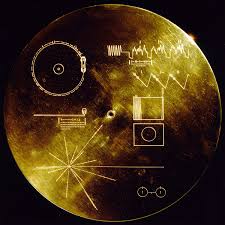
The Golden Record

HOVER OVER THE DATA BLOCKS TO DECODE THE COVER GLYPHS.
Audio Uplink // Sounds of Earth
TRACK: "GREETINGS FROM EARTH" 00:00

The Pulsar Map

Bottom-left starburst. Maps our Sun's location relative to 14 pulsars.

The Hydrogen Key

Bottom-right. Defines the unit of time (0.70ns) and length based on Hydrogen.

How to Play

Top-left. Visual instructions on how to operate the stylus and record.

Video Signals

Top-right. Explains how audio waveforms can be decoded into images.

System Log

The Grand Tour

MAR 1979
Jupiter

> Discovered volcanism on Io.
> Analyzed Great Red Spot.
> Confirmed ring system.

NOV 1980
Saturn

> Titan flyby priority.
> Analyzed hexagon storm.
> Sacrificed Pluto trajectory.

JAN 1986
Uranus

> Voyager 2 intercept.
> Voyager 1 was out of plane.
> No data collected.

AUG 1989
Neptune

> Voyager 2 intercept.
> Great Dark Spot imaging.
> Triton flyby complete.

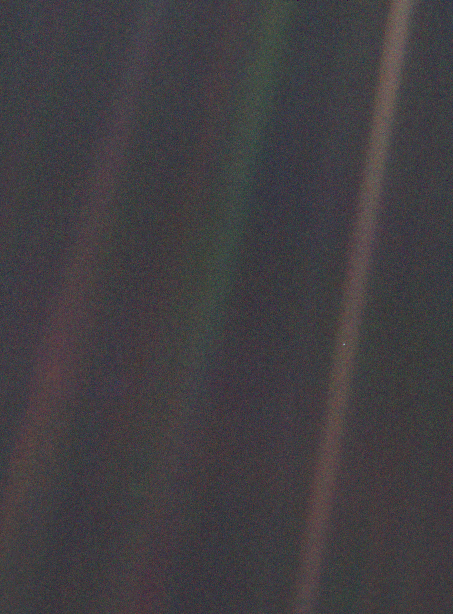
IMG_SEQ: VOYAGER_1 // 6 BILLION KM

The Pale Blue Dot

On February 14, 1990, just minutes before its cameras were permanently powered down to conserve energy for the interstellar void, Voyager 1 was commanded to look back. Across 6 billion kilometers of emptiness, it captured the final portrait of its origin. In that vast darkness, Earth was caught—a single, vulnerable pixel suspended in a scattered ray of sunlight.

"Look again at that dot. That's here. That's home. That's us. On it everyone you love, everyone you know, everyone you ever heard of, every human being who ever was, lived out their lives."
— Carl Sagan